Although he was born in Swansea, Wales, you do not have to search too far to notice the influence of John Charles on sport in Yorkshire.
There’s a street and a sports centre named after a man who, across two spells – but predominantly the first – became one of the most legendary players in Leeds United history.
Charles – who passed away in Wakefield on 21st February, 2004 – was also well known in Italian football thanks to the five seasons he spent with Juventus.
Juventus were not the only club he represented in Serie A, though. After a brief return to Leeds in 1962, Charles signed for Roma in November of that year, ultimately seeing out the season in the Italian capital.
Given his close connection to football in this county, it is something of a surprise that Giallorossi Yorkshire has taken this long to dedicate a feature to Charles’ 10 months at Roma.
This portion of his career is often merely a footnote in recollections of his story, but here’s the most in-depth story of a Leeds legend’s Roma spell…
How Charles joined Roma
After 105 goals in 182 games for Juventus, three Serie A titles and two Coppa Italia medals, and then some summer holidays in Liguria, Charles had been back at Leeds for less than 100 days, clouded by off-field issues with his marriage, when he understood it was time to move on.
Roma’s interest didn’t take long to spring up, but Leeds were initially hesitant to the idea. There was a board meeting for the English club on the afternoon of Monday, 1st October, 1962, which Charles attended and shook hands with Leeds chairman, Harry Reynolds.
Reynolds put out a statement explaining: “The board of directors considered the John Charles situation and, as a consequence, it was unanimously agreed that they would not consider any offer for the transfer of John Charles. The Football League, the Italian League and Roma FC [sic] have been notified of this decision.”
Yet over in Italy, Roma’s interest in Charles was highlighted again in the 15th October edition of Il Messaggero, the day after a draw with his former club Juventus – whose player Omar Sívori promptly claimed Roma had “everything it takes to aspire to the title.” But Roma’s coach, Luis Carniglia, confessed his team weren’t clinical enough. “Something is still missing from our game,” he admitted. “We need to find a way to exploit the team’s great play in the finishing.”
In turn, the report explained that Roma had “decided to return to the charge” for Charles, with an emissary “already on the verge of making contact with the president of Leeds,” which was Reynolds.
While Roma were hopeful of signing Charles, they simultaneously opened talks with his former club Juventus for his attacking colleague, Bruno Nicolè. However, Juventus preferred to try and sell Nicolè to Mantova as a counterpart for Angelo Sormani, who Roma were also looking at. (Incidentally, Sormani joined Roma a year later and Nicolè followed suit another year after that).
Another idea floated to regenerate Roma’s attack was a swap deal with Inter that would have seen Pedro Manfredini leave and Staffordshire-born Gerry Hitchens become Roma’s first English player. But Charles was Roma’s first target and work continued on the priority – helped along by the player himself.
On 22nd October, Charles told Leeds manager Don Revie that he wanted to go back to Italy. The Leeds board reiterated their desire to keep him, and after a meeting – which the player this time did not attend – Leeds announced their position was unchanged. But Roma then made an approach for Charles.
Still, Leeds said they weren’t prepared to sell him to an Italian club. Revie explained: “There is no question of this matter being reconsidered. The situation is unchanged.”
However, the manager admitted Charles had told him: “I would like to go back to Italy. I don’t think I am going to settle down here.”
One problem was that Leeds had already arranged to face Juventus in a friendly as part of the package agreed upon his return; the game was scheduled for 7th November. Revie made no secret of the fact that the game would lose its appeal if Charles wasn’t involved.
But Charles was absent from Leeds’ visit to Walsall on 27th October, with Revie attributing it to a heavy cold. Two days later, after Charles’ third request to go back to Italy, the Leeds board held a two-hour meeting and finally agreed to the move. On the same day, Charles spoke to a Roma representative and later told the press his move was to be regarded as “an accomplished fact.”
A statement by the Leeds board issued on 29th October, 1962 explained: “In consequence of John Charles’ repeated requests for a transfer, owing to John and Mrs. Charles not being able to settle in England and their desire to return to Italy, the Leeds United Board are reluctantly compelled to grant his request for a transfer. This is a great disappointment to the Board and supporters after their efforts to acquire and retain this player but in the circumstances no other course was left open to us.”
Charles and his wife, Margaret, had been keen for their three sons to be educated in England, which prompted their return to the UK that summer, but found there was an English school in Rome, alleviating what was seemingly by then the only doubt in their minds. In fact, his wife already flew out to Turin that weekend in anticipation of their return to Italy. The Roma deal was a goer.
An agreement was found on 1st November that saw Roma pay £70,000 (which was £17,000 more than Leeds had just a few months before to re-sign their former hero).
John Charles with Don Revie as Charles signs for Roma, 1962. The transfer was delayed for nine hours after difficulties with currency. pic.twitter.com/B4cbXWZP0L
— Leeds Football Newspaper Snippets (@leeds_snippets) January 13, 2025
Nevertheless, the following day there was a hold-up in the move. The drawing up of the contract and arrangement for a money transfer into a Leeds bank were left until the morning of 2nd November. Just after noon that day, Revie rang up the Elland Road ground to tell Charles to return. The player had been waiting to sign forms after Reynolds, Revie, Roma secretary Giovanni Paolillo and director Franco Pesci, accompanied by agent Gigi Peronace, acting on behalf of Roma, visited a bank and solicitor to finalise the details.
At Elland Road, Charles emphasised to the press: “I do not yet know my terms with Roma. These will not be settled until I arrive in Rome to meet the Roma president. My move back to Italy, I would like to stress, is not a financial one.”
Meanwhile, over in Turin, Juventus’ secretary requested that their friendly with Leeds be postponed, because they were unable to field a full-strength team. Leeds had refused to give Charles permission to play in Wales’ fixture against Hungary on 7th November because it would clash with his farewell appearance. A Roma spokesman said there had been no request from Wales for Charles’ availability, but conceded: “If such a request is made, it will be examined” – although he pointed to Roma’s Inter-Cities Fairs Cup fixture against Altay being on the same day.
As things started to fall into place, Corriere Dello Sport put a picture of Charles on their front page, with a banner headline in English reading: ‘Welcome, John’. He flew out to Rome on 3rd November to arrive in the afternoon and sign a two-year contract. Charles, then 30, conceded to the British press before his departure: “Clubs do not want players when they are 32 or more.”
Reflecting on the circumstances of his move years after his retirement, Charles explained: “Don Revie said, ‘We don’t want you to go really,’ but I took the chance, though I didn’t really like it. I didn’t care for Rome.” But, as with any account of a player, his story with Roma wasn’t as black and white as it would later be summarised as…
High hopes
At the time of his arrival, some Roma directors believed Charles was capable of replacing leading marksman Manfredini, who despite the exit links ultimately remained as one of the newcomer’s strike partners.
After all, Charles had previously scored four goals against Roma from eight previous meetings with Juventus in Serie A.
Roma had finished 5th in Serie A the previous season and were 8th after eight games at the time of Charles’ arrival. He was joining a club in transition, since Roma had replaced Carniglia as head coach with Alfredo Foni (for a second spell in charge) just days before.
Roma made room for Charles by selling defender Orvar Bergmark back to Örebro in his native Sweden after less than half a season, to ensure they weren’t at their limit for foreign players in the squad.
Charles signed his Roma contract in London on Friday, 2nd November in 1962. Roma president Francesco Marini Dettina hurriedly hired the services of a pilot to transport the contract to Rome’s Fiumicino airport by jet.
Vice-president Francesco Evangelisti (who went on to replace Marini Dettina at the summit in 1965) was tasked with securing two ministerial signatures to validate the contract by 2pm on the Saturday, in accordance with regulations about foreign footballers from the Ministry of Foreign Business. Evangelisti beat the clock and the document was flown to Milan to be approved by the league.
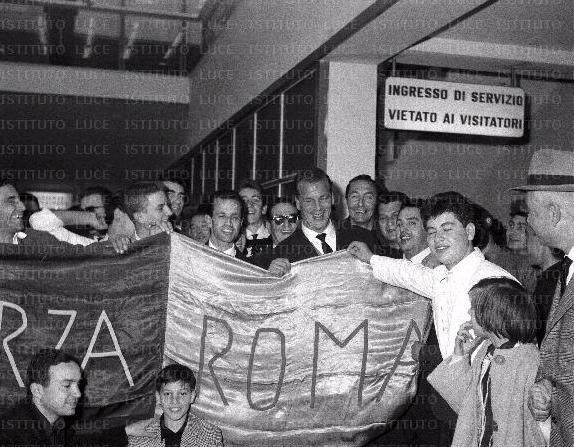
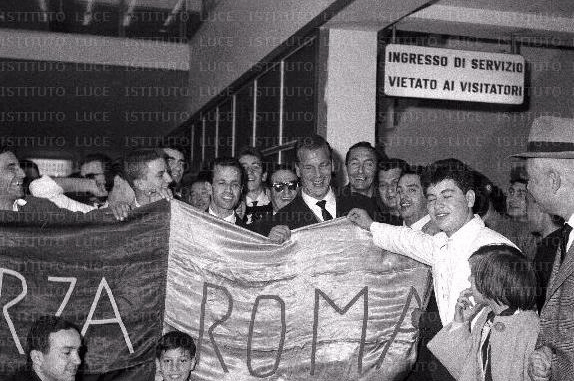
Charles landed in Rome on the afternoon of Saturday, 3rd November, 1962. A report in the following day’s Il Messaggero explained that “he was greeted with a show of affection from the numerous Giallorossi fans who had gathered at the airport with the inevitable red and yellow flags.” Charles “was immediately amazed by the warm welcome.”
Next, he was whisked off to sign the final pieces of paperwork to confirm his transfer and met up with coach Foni and his new teammates. Charles confirmed he was ready to get to work straight away, since he’d been in training with Leeds just a day before.
Charles told the press: “Roma has always had excellent teams. Players like Menichelli, Angelillo, Manfredini, Losi and Lojacono, who I admire a lot, are attractive to many clubs. I hope to be able to fit right into Roma’s system and settle in very quickly. I don’t know what role I’ll be assigned. Maybe a midfielder, but I’d prefer to play in tandem with Manfredini.”
Charles’ Roma debut
As hoped, Charles made his debut a day later. A preview in Il Messaggero of the home match against Bologna, which would be attended by 65,000 fans, affirmed that “one can easily imagine the enthusiasm, the anticipation, the curiosity of the Giallorossi fans” to see their new recruit. The report added: “The debut of a serious and impressive athlete like King Charles leads us to believe that Roma is already on the right track,” before predicting that he “could give the team the aggressive spirit and support” they needed against Bologna, who were top of the league at the time.
Foni originally planned to use him as a defensive midfielder, to combat Bologna’s attacker Helmut Haller, but Roma’s newcomer spoke with the coach, knowing he wasn’t in peak condition, and he was instead placed in the attack, where he could make up for his lack of stamina with periods of lower intensity.
Putting Charles in attack meant he was in the right place at the right time to make an early impression. A brace by Alberto Orlando inside the first 10 minutes – including a second goal set up by Giancarlo De Sisti, who himself received a pass from Charles – meant Foni’s side started on the right path.
About halfway through the first half, Charles had a goal disallowed for a foul in the build-up. But he would get his debut goal just before the hour mark when a cross by Paolo Pestrin evaded Bologna keeper Attilio Santarelli, allowing Charles to bundle home.
Moments after that debut goal, which there is footage of here, Charles came close to a second, heading the ball just over the bar after being picked out by an Alberto Orlando free kick.
President Marini Dettina was enthusiastic after the game, citing Charles as “a great player, the one we’ve been chasing for years.”
Shedding light on the process towards his signing, Marini Dettina explained: “It was a very difficult job. From six in the morning I was worried about the Welshman. Then, when I received assurances that the former Juventus player would arrive at Fiumicino Airport by 4pm, I sprang into action. There were many obstacles. I needed to obtain clearance from two ministries and the FIGC within a few hours.”
Charles himself reacted: “I was used to the enthusiasm of the Juventus fans, but today the Romans stunned me. It was truly impressive. And I have to thank everyone, because everyone supported me.”
He added: “Naturally, I dropped off towards the end; the pitch at the Olimpico is tough on your legs and in the first few minutes I pulled a muscle. And if I may, I must also add that I’m also a little tired from the journey.”
Promising midfielder Giancarlo De Sisti, who was still a teenager at the time, said in a column for Corriere Dello Sport the day after the game: “I immediately became friends with John. It’s not difficult to like John, because he inspired sympathy while being both so good and so modest […] I won’t deny that I was very excited when he joined the team on Saturday. I was almost ashamed to talk to him and I felt shy and awkward in front of him. And yet, he was the one who broke the ice […] He remembered me, and that made me blush […] He shook everyone’s hand and was very friendly with the few players who, like me, didn’t know him personally […] Now my dream is to play alongside John for as long as possible. I’m sure I’ll learn a lot from him.”
Many newspaper reports of the match had Charles in the headline. Corriere Dello Sport noted that Charles “inserted himself into the Giallorossi’s working with the authority of an unsurpassed champion” and cited the “instinctive understanding” he seemed to have developed with fellow striker Pedro Manfredini.
However, there was an acknowledgement that Charles wasn’t in full fitness. That same match report added: “Every time Charles got moving, the Giallorossi action reached heights never reached before. Unfortunately, as the minutes passed, his rhythm slowed and the whole team suffered.”
A day after Charles’ debut, he was among 22 players shortlisted by the Italian League for a match against the Scottish League, which would take place in Rome on 14th November. He was told he would be required to play in a practice game in front of selectors for the Italian League team. Meanwhile, Serie A pushed back the next round of league fixtures by a week to accommodate a weekend international game between Italy and Austria and then the game between the Italian and Scottish leagues.
Hosted at his new stomping ground of the Stadio Olimpico, the game was attended by 25,000 spectators. Charles was one of two Roma players selected, the other being future captain, Giacomo Losi. Also involved were his former Juventus teammate, Ernesto Castano, and another future Roma captain – who had just joined Juve – Luis del Sol. The Italian League won 4-3.
Early momentum
Charles didn’t end up playing in Wales’ game on 7th November, but he also missed Roma’s clash with Altay, which turned out to be the club’s all-time record win with a 10-1 scoreline.
But Foni chose Charles again in his next Serie A starting lineup two weeks after his debut, for a home game against a mid-table Fiorentina side.
Despite lacking the sharpness to react to an early chance on a pitch described as “heavy” by Corriere Dello Sport, Charles gave Roma the lead by heading in a ball by Pestrin.
He headed a couple more chances over the bar early in the second half before Manfredini doubled Roma’s lead. However, Foni’s side couldn’t hold on and ended up drawing 2-2.
In the match report, Corriere Dello Sport‘s writer admitted that, while Charles showed “superior instinct” to give Roma the advantage, he “moved little and, apart from the goal, did not do much.”
John Charles (far right) in action for Roma against Fiorentina pic.twitter.com/y2rUtA1snA
— The League Magazine (@Theleaguemag) May 30, 2017
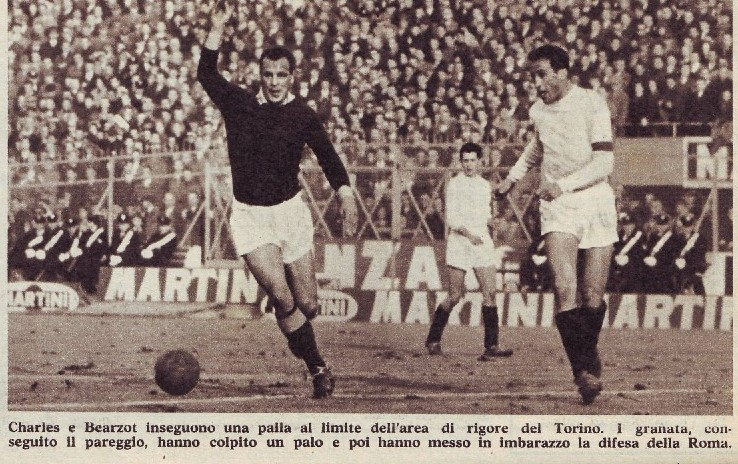
A week later, Charles was on the road with Roma for the first time, back in the familiar surroundings of Turin to take on Torino on a pleasant but cold day. While this was the first game he didn’t score for his new side in, he received praise in the following day’s Corriere Dello Sport for “never [getting his] position wrong and [acting] in covering the rearguard and reworking the counter-attacks with a genius and continuity that […] amazed us.”
Charles himself reflected: “After five years at Juventus, the match was a derby for me. I didn’t feel emotional, and it almost didn’t feel like playing away to me. I re-lived all the meetings with Torino and I fought like when I was at Juve.”
Next on the agenda for Roma was an Inter-Cities Fairs Cup clash with Zaragoza. Roma had booked their place in the round of 16 with the 10-1 win over Altay.
He was summoned for the trip to Spain, as Roma contested the first leg of their Fairs Cup clash, looking to make progress in a competition they had won two years before. At near-freezing temperatures and in foggy conditions that December Sunday, the game wasn’t short of goals, with the scoreline already 3-1 to Roma by the time Charles got in on the act and scored to make it 4-1 with 10 minutes to go. There was a late reply by the hosts, so it finished 4-2.
Charles started as the right winger in a 4-3-3 shape on this occasion, which enabled him to put some crosses in, but Foni allowed his attackers – also comprising Manfredini and Francisco Lojacono – to continually rotate their positions. As discussions about his form continued, Corriere Dello Sport concluded: “He is certainly no longer the ‘King’ of five years ago, but his contribution to the team is always of an axiomatic ability, because he always keeps two opponents busy.”
Charles showed his intuition when Roma got their third goal. Man of the match De Sisti played the ball towards him in the middle, but Charles deceived the keeper by opening his legs to let the ball through and over the line.
While that action showed a deft understanding of the game, Charles’ goal was all about power. The newspaper report explained how he “[threw] himself like a battering ram” between the opposing defenders, shaking them both off and then firing off a “fearful shot” into the bottom right corner.
Reviews become mixed
Back to domestic action a week later, and Charles – who was absent from the Coppa Italia loss to Genoa in between – was on the losing side with Roma for the first time since his arrival. A home game against Milan ended in a 1-0 defeat, with Charles unable to offer the same mobility that the unavailable Manfredini would have provided.
In fact, Corriere Dello Sport wrote that he was as “immobile as a statue” and criticised his struggles in crowded areas. Specifically, he was marked out of the game by future Italy manager Giovanni Trapattoni, who even won aerial duels against Roma’s lofty forward.
Manfredini himself defended Charles, though, telling the media: “John was left too alone in the middle. When we played together, it was different. He didn’t need to stand still in the middle of the box waiting for the ball, and I moved around to create space for him. Instead, he was left alone and suffocated. What do you think? Is it easy for a centre-forward to play in Italy? It’s easy to criticise!”
The following week, Charles bounced back when Roma visited Genoa. Torbjörn Jonsson gave Roma an early lead, but the goal was “all [Charles’] work”, according to Corriere Dello Sport. After a free kick, he headed the ball over the onrushing keeper, for Jonsson to poke home, but there was a feeling Charles’ header would have gone in itself even if Jonsson hadn’t touched it.
Charles was heavily involved in Roma’s attacks, using his aerial strength but also dribbling and taking on some shots. He later scored the equalising goal, struck powerfully with his right foot into the top corner to leave the opposing goalkeeper “astonished”. Then, just before full time, his cross-shot caught out the Genoa defence and was turned in by Alberto Orlando, only for what looked like a winning goal to be contestably chalked off for an offside. Nevertheless, the press report concluded that Charles “performed well, always representing a serious danger for all defences: in short, he must never be sent to the slaughter like against Milan again.” However, there were still accusations in the press that he needed to lose a bit of weight.
But La Stampa‘s report was even bigger in its praise, pointing out that Charles was “growing, Sunday after Sunday” and “rediscovering his former vigorous boldness, his constant, grinding, powerful rhythm. He’s about to explode, perhaps, in a second sporting spring, all Italian in character, full of tenacity, skill, serious and professional commitment.”
Ballon d’Or candidate
On 18th December, Charles made a bit of history, by finishing in 8th place in the 1962 Ballon d’Or ceremony. Although that was mainly in recognition of his efforts for Juventus in the first half of the calendar year, it made him the first ever Roma player to be nominated for the Ballon d’Or.
Then, two days before Christmas and after being left out for the second leg against Real Zaragoza, which was a day after the Ballon d’Or ceremony in Paris (Roma’s announcement said he was ‘slightly indisposed’) Charles scored for the second league game in a row, taking his Roma tally to five goals from seven games. This time the victims were Sampdoria. Charles was fouled for the penalty Manfredini scored to give Roma the lead; then, the favour was returned for the second goal, which was a Charles header after sprinting to latch onto a Manfredini cross.
In Corriere Dello Sport‘s report this time, it was stated that Charles “appeared from the beginning to be able to intimidate the opposing backlines by himself.” A slower flow of the game in general was also deemed to have worked in his favour. In one word, his performance was summed up as “decisive”.
Head coach Foni observed afterwards that Charles – and Manfredini – were “clearly recovering”, before the Welshman himself confirmed full fitness was close.
“I feel much better,” Charles insisted. “I’ve even reached my ideal weight. Now it’s a matter of maintaining that standard.”
It was the last league game he ever scored in for Roma.
Fitness takes a toll
Against Inter the next week, Corriere Dello Sport wrote: “It was a shame to see him wandering around the pitch, more harmful than useless, in search of a ball that always passed under his nose and that made him look ridiculous from the first to the last moment.”
John Charles #Roma 1962-63 … pic.twitter.com/JtZiBlcmmM
— Richard Whittle (@RichWman) August 26, 2021
A lack of mobility was once again evident, with Charles taking the blame for not even moving to get on the end of one chance in a good position in the first half. Losing his individual battle with Inter’s Bruno Bolchi more by his own demerit than his opponent’s merit, it was claimed that Charles “practically denied Roma the counter-attack.”
La Stampa concurred, describing Charles as “almost a spectator throughout the match” and “incredibly static.”
Foni’s verdict was: “With [Sergio] Carpanesi in the midfield, Charles should have remained alongside Manfredini to form the striker pairing that has performed so well in recent weeks. However, with Carpanesi gone, Charles had to move back and therefore he didn’t bring the contribution to the team that I had hoped for.”
Thus, after seven starts in a row in the league, Charles was rested for the next game, away to Atalanta. Substitutes didn’t exist in Serie A at the time, so if you were out of the starting lineup, you had no chance of playing.
Charles would return in the next game against Venezia, but the week off wasn’t deemed to have done him much good. La Stampa described his break as “useless” and said he was “bogged down” in the 2-2 draw, which was overshadowed by protests by the Roma fans against Marini Dettina.
That was in the middle of January. Charles’ next competitive appearance for Roma wouldn’t come until two months later, as he missed eight Serie A games – including the trip to his old stomping ground against Juventus – and one in the Fairs Cup before putting his boots on again for a trip to Bologna in March.
During that absence from competitive action, Charles did feature for Roma in a February friendly against Como, which was a 5-1 win at Stadio Tre Fontane, operating in a different role as a defensive midfielder or sweeper. However, he tore a muscle in his right thigh, forcing his absence to be prolonged.
On 14th March, Charles returned in another friendly, against Ostia Mare, once again as a defensive midfielder. Roma won 4-2 ahead of their next competitive game, three days later.
On that occasion, Charles’ comeback was disappointing. A match report in L’Unità dubbed the 0-0 draw with Bologna a “festival of boredom”.
John Charles, Roma#ASRoma #IGiallorossi pic.twitter.com/yrjB6BCzo6
— Football Memories (@footballmemorys) March 21, 2024
Another seven-game streak of absence followed for Charles, interrupted only by his involvement in a March friendly against the Poland national team in Warsaw and Roma’s 3-0 loss to Valencia in the away leg of the Fairs Cup semi-final (his predicted involvement in the second leg of the quarter-final against Red Star Belgrade never came to pass). L’Unità explained that Charles “was reluctant to play in an unusual role” after being deployed on the wing. He wouldn’t have to again. In fact, he only had one more Serie A appearance to come for Roma.
The end nears
It was on the last day of the season, against Venezia in May. By this point, there was nothing to play for. Roma finished 5th in Serie A, the same position they achieved the season before (when Charles’ Juventus came down in 12th).
L’Unità concluded that Charles “was touching for his consistency and dedication, but his performance now inevitably reveals the weight of a long and generous career.”
Roma rounded out the season with some friendlies. Their first visitors were Matt Busby’s Manchester United, who won 3-2 at Stadio Flaminio in a game in which Charles featured.
Things came full circle four days later when Roma welcomed Revie’s Leeds United for a friendly, which had been agreed in advance as part of the package to bring Charles to the Italian capital. Against his former club and ex-teammates such as Billy Bremner, Jack Charlton and Norman Hunter, Charles played in attack as Roma won 2-1.
But there was background noise building up about his status at Roma. A report in L’Unità the following day explained that Charles didn’t want to be sold and had no intention of returning to England. However, regulations meant Roma wouldn’t be able to sign a new foreign player, which put their pursuit of Jürgen Schütz at a standstill.
Two more friendlies in which Charles played followed the Leeds game: one against Monaco, a 3-2 win at the Olimpico, and one against a Santos side starring Pelé, which Roma lost 4-3 despite Charles hitting the crossbar.
Then, there was a final hurrah for Charles, who scored for Roma in the post-season Coppa delle Alpi – a tournament held in Switzerland, solely between Swiss and Italian clubs – in June. Just a day after the Santos friendly, he scored Roma’s equaliser with a powerful shot in what became a 7-1 win over Grasshoppers. In fact, Charles set up the second and third of Roma’s goals as well, before suffering from pain in his thigh in the second half.
Three days later, he took to the field in Roma colours for the final time. In another full circle moment, the opponents were Juventus, again in the Coppa delle Alpi. Carrying a knock from the Grasshoppers game, Charles wasn’t in peak condition and was withdrawn at half time (substitutions were allowed in the friendly competition) of the 2-0 defeat.
Roma went on to win the third-place play-off of the Coppa delle Alpi, but Charles had no further involvement and so ended his spell with the club with 6 goals from 14 games. He played no part in any pre-season fixtures before being sold in August 1963.
Charles’ complicated Roma exit
While he had previously been keen to avoid a return to England, he moved back even closer to his original home by signing for Cardiff City. But it was a complicated process that took over a month – and a return to Yorkshire with Huddersfield Town was an alternative option.
Charles said on Saturday, 6th July, 1964, in quotes printed in the following morning’s Sunday Express: “I am very happy indeed at the thought of returning to Britain and so is my wife. At this moment I am not sure what is happening, but I am sure that Roma will be willing to transfer me, because they want to sign another foreigner. They wanted me to go to Spain and then to Switzerland, and I said that I would prefer to go home. I don’t think they will ask a big fee. I have read that Cardiff and Swansea are interested, but know nothing beyond that.”
By Thursday, 11th July, British newspapers explained that negotiations between Roma and Cardiff were proceeding. The Welsh club held talks with agent Peronace (who, prior to his involvement in Charles’ transfer to Roma, had also overseen his original move to Juventus in 1957, the same year he talked Roma into appointing Alec Stock, who remains their most recent English head coach).
“I think Charles is all for joining Cardiff,” exclaimed Peronace. “Nothing in the way of figures has been agreed.”
Cardiff confirmed they would be meeting Peronace again on Monday, 15th July. But the day before, the Express reported that Peterborough United were also ready to rival them in the bidding for Charles.
Moreover, on Wednesday, 17th July, when Peronace met with Cardiff directors again, the Huddersfield Daily Examiner reported that Huddersfield Town could be “dark horses” in the race for Charles.
Their manager, Eddie Boot, said noncommittally: “We are interested in several players at the moment. Charles could be one of them.”
The report in the Huddersfield Daily Examiner said Charles was “anxious to return to English football” and Roma were “willing to talk transfer business.” The fact that his wife was “a Leeds girl” was a potential factor in Town’s favour, while the report also noted Charles was “well over a stone lighter than when he played at Leeds Road” against Huddersfield at the start of September 1962, two months before his Roma move.
The plan for his potential return to the English Second Division would be to play as a centre-half again. But Cardiff remained the main suitors and now put £20,000 on the table for Roma. As the battle for his services commenced, a Cardiff correspondent in the paper said: “Whatever the outcome of today’s meeting, there would have to be more talks with Charles himself on the matter.”
Cardiff manager George Swindin said: “We are now hoping to meet Peronace on Thursday morning. We have heard nothing of Roma’s reaction to our offer and until we see Mr Peronace we are as much in the dark as anyone.”
Welsh footballing great John Charles pictured here with officials of Cardiff City and Roma during his transfer from the Italian club in August 1963. pic.twitter.com/aUyHPlOe6N
— Bluebirds Past (@BluebirdsPast) May 15, 2023
As hoped, more talks with Cardiff for Charles took place that Thursday, 18th July, although Peronace was initially held up on his return from Italy. The key issue he would have to resolve was the gap in valuations between the two clubs; Roma wanted £30,000 for Charles, not the £20,000 on offer from Cardiff. No decision was reached by the end of the day.
Peronace left Cardiff for London and said on Friday, 19th July: “I do not know whether I will be back in Cardiff. I am not trying to conduct an auction for Charles. My instructions are to sell him for £30,000 and if a British club offers that amount I must accept.”
On the back of Cardiff’s £20,000 offer, Peronace came to West Yorkshire for talks with Huddersfield Town directors on Saturday, 20th July, which lasted around 90 minutes. Boot said a figure was mentioned in their own talks, but no agreement was reached and there would possibly be another meeting.
Their interest hovered as the new week began, but Cardiff were ready to put the pressure on. Cardiff’s chairman, Ron Beecher, said on the evening of Monday, 22nd July that he would give Roma until 10am the following day to accept or reject their offer. But Roma responded that they would probably ask Cardiff to postpone the imposed deadline.
Nevertheless, the evening papers on Tuesday, 23rd July relayed that a deal had been agreed. Charles was expected at Cardiff’s Ninian Park ground within the next 24 hours. Peronace said: “I think Cardiff have got a bargain for, with Charles in a happy state of mind, I am convinced that he can remain a great player for several seasons.”
On top of the £20,000 fee, it was arranged for Roma to face Cardiff in a friendly, initially expected to be at Ninian Park in mid-October.
But there was still to be a twist. Although on Wednesday, 31st July, Cardiff’s manager said Charles would sign the next week after agreeing terms, and he did travel overnight to the Welsh capital on Friday, 9th August, announcing his intention to sign for the club after arriving three hours later than scheduled and then going on to fill out the necessary forms at Ninian Park, he would soon be beset by registration issues with the Football League.
Leeds alleged Roma still owed them £10,000 of the transfer fee for Charles – and, while they were at it, Juventus still owed then £6,000 from six years before.
On Monday, 19th August, Roma’s secretary, Dr Valentini, said: “Leeds cannot stop the transfer. As far as Roma are concerned the player has been transferred to Cardiff.” But he declined to reply to the question of if Roma still owed money, saying it was an internal matter.
Ultimately, the stalemate was resolved when Football League secretary, Alan Hardaker, said on Saturday, 24th August: “I have received a telegram from Roma FC [sic] informing me that Cardiff City have been authorised to pay Leeds United the outstanding balance of the John Charles fee and the matter is now satisfactorily settled.” The balance was to come out of the £20,000 Cardiff paid Roma.
Charles’ exit enabled Roma to finalise the addition of Schütz. Roma went on to win their first Coppa Italia trophy the following year, in November 1964.
The final reunion
But before then, they crossed paths with Charles one last time, in the aforementioned friendly with Cardiff. Rather than taking place at Ninian Park, it saw the Welsh outfit come to Italy, hosted by Roma not at the Olimpico but at Stadio Flaminio, on 10th May, 1964 – three days after Cardiff faced Charles’ other ex-Italian employers, Juventus.
In front of 15,000 fans, who gave Charles a good reception, Roma won 4-1. Marked through the game by Losi, Charles had a header at the end of the first half saved by Roma keeper, Enzo Matteucci. One account of the game by the Italian press said Cardiff were “fairly decent” in the first half but “literally collapsed” in the second.
After the game, Charles said: “When I took to the field with my Cardiff here, at the Stadio Flaminio, the rhythmic ‘John, John, John’ filled me with nostalgia and pleasure. Then the applause when I got one of my headers spot on! It means that the Romanisti still love me and remember me.”
Drinking orange juice in the changing room while all his Cardiff clubmates chugged back beers, Charles was asked what he thought of Roma’s new, younger players: specifically Mauro Nardoni, Francesco Carpenetti and Fulvio Francesconi, each of whom would make their debut in the 1963-64 season.
But Charles paused and reflected, before stating: “I’ll tell you about these young players later. Now I’d like to express all my admiration for ‘Picchio’ De Sisti. I knew him; he was coming out when I was leaving the club. But the De Sisti I saw against us now is a big midfielder […] De Sisti has become a great fighter, and his goals, especially the second, show that he’s become tough, determined. I think he’ll improve further. Bringing up midfielders, in today’s difficult game, is rare. I think De Sisti is the midfielder of tomorrow, for the national team…
“Roma has a jewel in its hands in De Sisti, who shouldn’t run the risk of deteriorating… as he grows. Of course, to further improve, De Sisti needs players behind him who fully understand him. So, yes, I’ll hazard a guess: De Sisti will make the national team.”
Accordingly, De Sisti made his Italy debut in November 1967, four years later, by which time he was playing for Fiorentina, and earned a final total of 29 caps. He was a member of the Italy squad that won Euro 1968 and were runners up to Brazil at the 1970 World Cup, four years before he returned to Roma, whose Hall of Fame he was inducted into in 2016.
Returning to the academy prospects, Charles concluded: “Nardoni has shown he knows how to play. He hasn’t been consistent, but you have to understand these ‘youngsters’, who are brought into the team ‘for the occasion’.
“I liked Carpenetti and he only had a tough time in the first 20 minutes.
“Francesconi is a strong winger who, in my opinion, needs a strong partner to give him a good start. He’s a winger who should improve; playing as a winger today, with the defence strengthened, is more difficult than it used to be.”
After his interviews, Charles went to meet Manfredini, who he described as a “very good friend of mine”. They conversed, in Italian, about life in South America and Wales, before going their separate ways. Charles never played in Italy again.
Charles stayed with Cardiff until 1966, before player-manager spells with Hereford United and Merthyr Tydfil. His appearance tally for the latter remains unknown, but of his professional clubs, Roma were the one he finished with the lowest proportion of games for.
“Rome is a great city, but I just didn’t get on, either playing wise or socially,” Charles later reflected. “The people in the North are different from the people in the South. It’s the same in England, the same in Wales and definitely the same in Italy.”
Roma remember Charles
Decades later, the day after Charles passed away at the age of 72 in February 2004, there was a minute’s silence before Roma’s 6-0 win over Siena, in which Roma’s players wore black armbands as a gesture of remembrance.
No Welshman has played for Roma since – indeed, only three have played elsewhere in Serie A: Ian Rush and Aaron Ramsey for Juventus and future Leeds captain Ethan Ampadu for Venezia and Spezia – and it wouldn’t be until 2014 that another Brit did, with the arrival of Ashley Cole.
Similarly, Cole came with a reputation of being an elite player from his previous successes, but being towards the end of his career, he couldn’t match those standards in Rome. Instead, the first British Roma player to be a quantified success was Chris Smalling from 2019.
Charles was finally overtaken as the highest-scoring British Roma player in November 2021, when Tammy Abraham scored his seventh goal for his new club.
Charles’ most iconic moments may have been with other teams, but his time with Roma had more to reflect on than you might expect.
Giallorossi Yorkshire would like to express thanks to Lorenzo Contucci from asromaultras.org for his helpful assistance with sourcing historical coverage of Charles’ arrival at Roma and footage of his goal against Bologna, and to Leeds Football Newspaper Snippets on X for their support with finding local coverage of Charles’ move from Leeds to Roma.

Leave a Reply