
As refreshing as it has been, the time for sentiment is over and it is now back to the nitty gritty as Roma prepare to return to action in Claudio Ranieri’s third spell in charge.
Ranieri has already captivated the Roma fanbase again after his unifying introductory press conference, but the first game since his return is quickly creeping up – and it looks like a challenging one.
On Sunday, Roma are due to visit Napoli, a team with already twice as many points as them in Serie A this season. It kicks off a difficult first week of games for Ranieri, who will have to come up with a plan for the pitch to ensure his messages of motivation do not evaporate.
According to reports in Italy, Ranieri has been testing out a 4-4-2 formation in training ahead of his first game back at the helm. It is a system he has been synonymous with before – think back to his Premier League title win with Leicester City – even if he has tried to dismantle that association before and used a back three more often in his most recent job with Cagliari.
Especially on English shores, the 4-4-2 is seen as a back-to-basics formation, one that every player understands intuitively. However, Roma haven’t lined up like that for a particularly long time, and with good reason. Rarely in recent years have they had the players suitable for that shape. Yet now, Ranieri might be on to something.
Embed from Getty ImagesLet’s start from the top. In theory, the two players up front would be Artem Dovbyk and Paulo Dybala. They simply need to be playing close to each other to be of maximum benefit to Roma. Under Ivan Juric and Daniele De Rossi before, Dybala often had to cover a wider role, which meant more defensive responsibility – which he dutifully undertook, especially in the last few games of Juric’s brief reign. But La Joya is at Roma to attack, and he is far more dangerous centrally.
During his debut season at Roma, which he finished as their top scorer, Dybala often played in a strike partnership with Tammy Abraham. Staying close to the striker allowed better link-up play, even if it wasn’t Abraham’s best season. Dovbyk, in contrast, has been doing reasonably well since joining Roma, who haven’t yet been playing fully to his strengths. If those two can carve out an understanding and link up better on the pitch, Roma might get more effective at creating and converting chances.
But for a 4-4-2 to work, there needs to be strength out wide as well, which is something that has held Roma back recently. However, players like Stephan El Shaarawy and Nicola Zalewski – who have learned how to play as wing-backs when Roma used a 3-5-2 or variant – could be ideal in balancing both phases of play in those positions. The same would go for the soon-to-return Alexis Saelemaekers. Roma just need to hope their crossing can improve to assist Dovbyk, but there should be more opportunities to at least attempt it.
Yet, with Zalewski out of form for a considerable amount of time, there could be other solutions too, such as the indications that Lorenzo Pellegrini could play as a left-sided midfielder. It’s a role coaches have flirted with putting him in before, so it would be interesting to see how he might be able to contribute from that kind of angle, especially when his performances centrally have been under scrutiny.
And in that central midfield territory, box-to-box players will be needed to make the 4-4-2 work. Summer signings Manu Kone and Enzo Le Fee could come into their own in this regard, while breakthrough talent Niccolo Pisilli seems suited for it too. Could it even bring a different layer to Bryan Cristante’s game? Potentially. In contrast, Leandro Paredes might not fit in, but he hasn’t been playing well – or frequently – anyway.
Finally, a back four will represent a major change for Roma. Juric religiously stuck to a back three, even when it meant limiting Angelino, who should fare better as a full-back. Before Juric, every coach since Ranieri’s second spell – Paulo Fonseca, Jose Mourinho and De Rossi – started out by trying to use a back four, but realised the squad wasn’t suited and reverted more regularly to a three.
Since Mats Hummels isn’t anywhere near as up to speed as expected, Mario Hermoso has failed to impress and Ranieri has promised Angelino will be restored to his natural role, Roma’s central defensive options are limited. Finally, they might be better off with a four, as long as the midfielders in front of them work hard. Zeki Celik isn’t a dangerous attacking right-back, so he could sit in the backline, while Angelino would be allowed more freedom to move up the pitch on the opposite side.
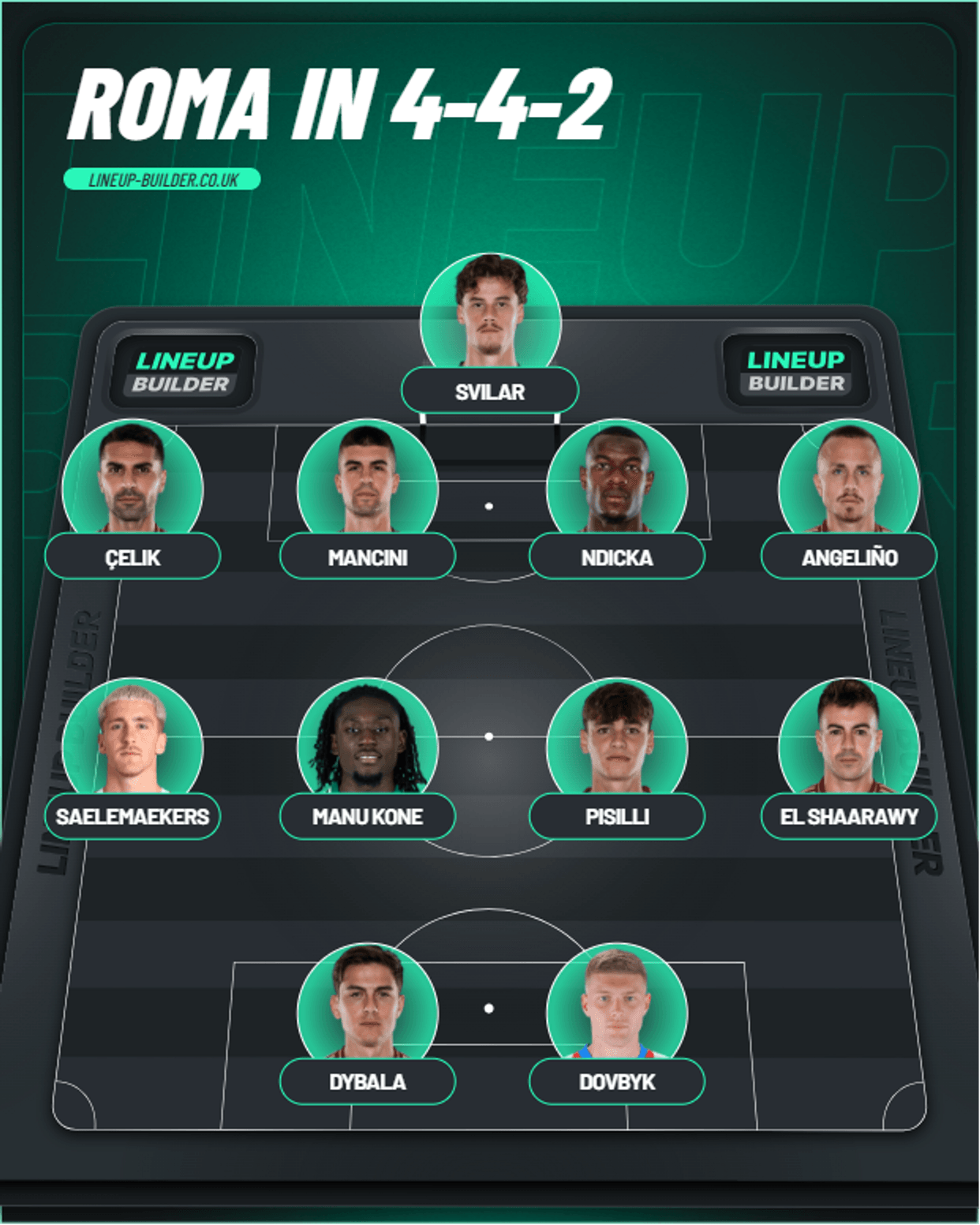
One example of how Roma could line up in a 4-4-2
Indeed, while 4-4-2 could be a starting shape, there should be some flexibility afforded when opening games up. Dybala could drop into a number 10 role, Pellegrini could come inside – equally if it was someone like Tommaso Baldanzi or Matias Soule, who otherwise might end up as square pegs in round holes – or Roma could create overloads on one flank. They have rarely been effective enough out wide in one-on-one situations, so it’s worth a try.
On paper, 4-4-2 is a solid defensive structure as long as the players hold their shape. In the offensive phase, if fluidity is encouraged, Roma could explore more angles of attack. It might just work – and there has been enough time in this international break to try and make it functional.
But whatever the shape, Roma’s players need to lift their levels on the pitch from here on out. Being in the bottom half of the table and on a third coach of the season 12 games in sums their recent predicament up. Now, there has been a sense of taking a step back to take a step forward. It will take time to restore trust from the fans; that journey is starting from near zero again.
But as Roma go back to basics, they will hope to find a way to navigate forward.

Leave a Reply